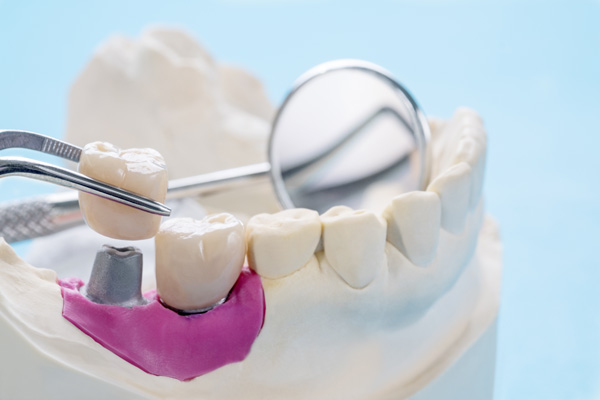
Though implant crowns and traditional dental crowns look almost identical, they serve different purposes. Implant crowns are key to tooth replacement involving dental implants, while traditional ones primarily reinforce and repair natural teeth. Understanding the differences between these options can help patients make informed decisions regarding restoring their smile.
What are implant crowns?
Implant crowns are attached to a dental implant, a small titanium post surgically placed into the jawbone. This post acts as an artificial tooth root, providing a stable foundation for the crown, the visible part of the replacement tooth. Implant crowns are an effective treatment for patients who have lost a tooth due to trauma, decay, or gum disease.
There are several steps to the dental implant process, starting with the surgical placement of the titanium post. Once the post integrates with the jawbone through osseointegration, a custom implant crown is designed to seamlessly complete the patient’s smile. This crown is securely attached to the implant using an abutment, restoring form and function.
What are traditional crowns?
Traditional crowns, on the other hand, are caps placed over existing teeth to restore their shape, size, and strength. These crowns are often used for natural teeth that are cracked, weakened, or severely decayed. Sometimes, a dentist will recommend a traditional crown to improve the appearance of discolored or misshapen teeth.
The natural tooth must be reshaped to accommodate the traditional dental crown. After taking an impression of the tooth, a dentist sends the impression to a dental lab, where a technician constructs the crown. Once the crown is ready, the dentist checks its fit and cements it onto the prepared tooth.
Key differences between implant crowns and traditional crowns
Placement method
The placement method is a key difference between these two crowns. Implant crowns require a dental implant to anchor them securely in the jawbone. This approach involves surgery and a healing period that can take several months before the crown is attached. In contrast, traditional crowns are placed over a prepared natural tooth. This process, which can take a few weeks or less, does not require surgery or a long healing period, making it a quicker option for many patients.
Support structure
Traditional crowns depend on the natural tooth for support. Therefore, if that underlying tooth is compromised, it can limit the crown’s effectiveness, and additional procedures may be needed. Conversely, implant crowns rely on the strength of the dental implant, which mimics a natural tooth root. This integration with the jawbone provides excellent stability and prevents bone loss in the area that suffered the missing tooth.
Durability and longevity
Implant crowns are known for their durability and long-lasting results. With proper care, they can last decades, making them a reliable solution for tooth replacement. Traditional crowns, while also durable, may require replacement after 10 to 15 years due to wear or damage.
When to choose implant crowns
In addition to their longevity, implant crowns help preserve jawbone health, making them excellent for tooth replacement. When a tooth is lost, the jawbone in the area may begin to deteriorate over time. An implant crown stimulates the bone, helping prevent this deterioration and maintain facial structure.
When to choose traditional crowns
Traditional crowns are restorations for natural teeth. Therefore, a dentist recommends them for patients with damaged or weakened teeth that need reinforcement. They are ideal when the tooth root is still healthy but needs added support. Traditional dental crowns are instrumental in reinforcing and restoring the function of root canal-treated teeth.
Getting the most out of crowns
Good oral health and hygiene remain important after tooth repair and replacement. In both cases, patients should take extra care when cleaning around the restoration. Additionally, they should avoid chewing on hard objects, which could damage the crown. Regular dental checkups also remain important. At these appointments, the dentist can inspect the implant or crown for any signs of damage, decay, or inflammation. As with natural teeth, good oral care is key to making an implant and traditional crowns last.
Repairing and restoring teeth with dental crowns
Both implant crowns and traditional crowns are important in restoring and maintaining dental health. Implant crowns replace missing teeth, providing long-term stability and preserving jawbone health, while traditional crowns effectively restore natural teeth. Dental care decisions can feel overwhelming with all the options available today. However, a trusted dental professional can provide guidance to help you find the right fit for you. Call today to learn more about our options for repairing and restoring your smile.
Request an appointment here: https://www.southerncalsmiles.com or call Southern Cal Smiles: Susan Fredericks, D.D.S, M.P.H. at (818) 657-8055 for an appointment in our Woodland Hills office.
Check out what others are saying about our dental services on Yelp: Dental Implants in Woodland Hills, CA.
Related Posts
A bone graft for dental implant restoration may be recommended by a dental professional to restore the density inside of the jawbone. This should take place before the placement of dental implants if the patient has lost density in their jawbone due to atrophy following tooth loss or as a result of periodontal disease.Although needing…
Root canal treatment often sounds intimidating, yet endodontics focuses on relieving pain and saving natural teeth with precise, evidence-based techniques. An endodontist specializes in diagnosing tooth pain and treating the soft tissue within the tooth. When deep decay, cracks, or prior dental work inflame the pulp, bacteria gain access and create significant discomfort. A root…
Dental veneers and dental crowns are restorations that can change the appearance of your teeth. Though they are different procedures, people often confuse the two. This article will review the key differences between crowns and veneers to help you better understand which procedure is right for you.A dental veneer is a thin covering for a…
A dentist provides a variety of preventive, diagnostic, and restorative services that support your long-term oral health. These services offer technological advances and newer methods in modern dentistry that improve your comfort and treatment outcomes. The following guide provides the information you need to know about what to expect from a dentist offering modern dental…